 English
 Español
 русский
 عربى
عربى 中文简体
中文简体
Content
- 1 Why Getting Cabinet Selection Right Matters More Than Ever
- 2 Understanding the Compliance Landscape for Tobacco and Wine Display
- 3 Cabinet Types and Their Suitability for Supermarket Environments
- 4 Key Features That Maximize Product Exposure Without Compromising Compliance
- 5 Comparing Cabinet Specifications: A Practical Selection Reference
- 6 Space Planning and Positioning for Maximum Sales Impact
- 7 Sourcing and Quality Checklist for Retail Procurement Teams
Why Getting Cabinet Selection Right Matters More Than Ever
Supermarket tobacco and wine cabinets sit at a unique intersection of retail merchandising and regulatory compliance. Unlike standard shelving or display fixtures, these cabinets must simultaneously showcase products attractively to drive sales, restrict unauthorized access to age-controlled items, and conform to an increasingly complex web of local, national, and international display regulations. A poorly chosen cabinet can result in compliance penalties, reduced product visibility, staff inefficiency, and lost revenue — all at once. Getting the selection process right from the outset is therefore not just a purchasing decision but a strategic one that affects store operations, legal standing, and bottom-line performance every single day.
Understanding the Compliance Landscape for Tobacco and Wine Display
Before evaluating any physical cabinet specification, retail buyers and store planners must have a thorough understanding of the regulatory environment governing tobacco and wine display in their specific market. Tobacco display regulations vary significantly by country and even by region within countries. In many jurisdictions, tobacco products must be stored completely out of customer sight behind opaque or frosted panels, with products only visible to staff during a transaction. Other markets permit limited visibility displays but require prominent health warning panels to be incorporated into the cabinet design itself. Wine and alcohol regulations are generally less restrictive regarding visibility but often mandate lockable access during non-trading hours and may impose specific signage requirements near the display point.
Supermarket operators must consult with their local regulatory authority before finalizing any cabinet specification to confirm exactly what is and is not permitted. Selecting a cabinet that fails compliance — even inadvertently — can trigger fines, forced refit costs, and in serious cases, suspension of the license to sell tobacco or alcohol on the premises. Compliance must therefore be treated as a non-negotiable baseline requirement, not an afterthought.
Cabinet Types and Their Suitability for Supermarket Environments
Supermarket tobacco and wine cabinets are available in several distinct configurations, each suited to different store formats, product ranges, and compliance requirements. Understanding the practical differences between these types is the foundation of any informed selection process.
Roller Shutter Tobacco Cabinets
Roller shutter cabinets are the most widely adopted format for tobacco display in compliance-heavy markets. When closed, the shutter completely conceals all products from customer view, satisfying plain packaging and out-of-sight display laws. When a staff member opens the shutter — either manually or via an electronic push-button or foot pedal mechanism — the full product range is revealed in an organized, tiered layout that allows rapid transaction completion. These cabinets are typically wall-mounted behind the checkout counter and can be specified in widths from 600mm up to 3000mm or more, making them scalable to both small convenience-format supermarkets and large hypermarkets.
Glass-Fronted Wine and Alcohol Display Cabinets
For wine and premium spirits, glass-fronted display cabinets offer the product visibility that drives impulse purchases and supports brand storytelling. These cabinets use toughened glass doors — either hinged or sliding — combined with internal LED lighting to present bottles attractively while maintaining lockable security outside trading hours. Temperature-controlled variants are available for supermarkets that stock premium wines requiring cellar conditions, with internal temperatures typically maintained between 8°C and 18°C. Glass-fronted cabinets are most effective when positioned in a dedicated wine and spirits aisle or at a high-footfall end-of-aisle location where dwell time is sufficient to influence purchasing decisions.
Combined Tobacco and Wine Cabinets
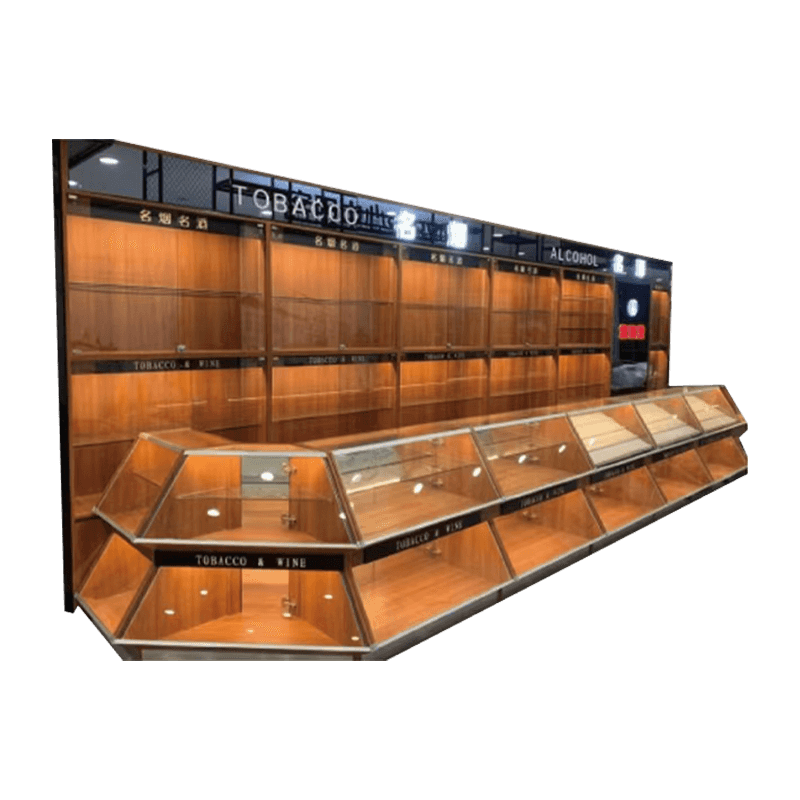
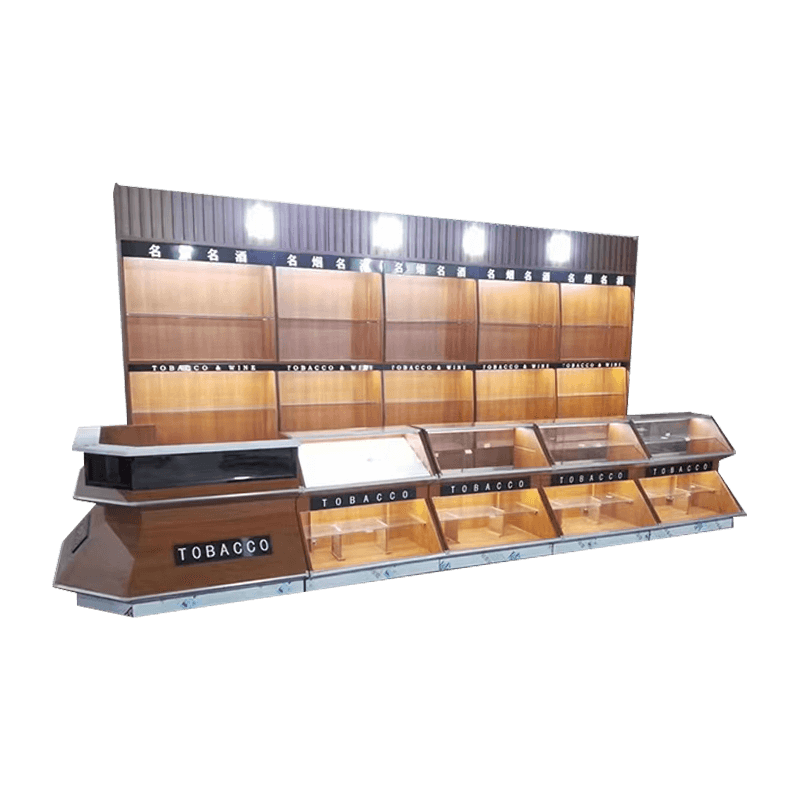
Some supermarket formats, particularly smaller convenience-oriented stores with limited floor space, benefit from combined units that integrate tobacco storage with wine or spirits display in a single cabinet assembly. These hybrid units typically feature a roller shutter or opaque panel section for tobacco concealment in the upper portion and glass-fronted shelving for wine and spirits in the lower section. While space-efficient, combined cabinets require careful planning to ensure that the tobacco concealment section fully satisfies regulatory requirements independently of the wine display section, as the two product categories are governed by different rules.
Key Features That Maximize Product Exposure Without Compromising Compliance
The best supermarket tobacco and wine cabinets achieve maximum product exposure within the boundaries set by compliance requirements. The following features are critical to achieving this balance effectively:
- Tiered and Adjustable Shelving: Internal shelving that can be reconfigured to accommodate different pack sizes and bottle formats ensures that every centimeter of cabinet space contributes to product display density without wasted gaps or obscured items.
- Integrated LED Lighting: High-quality LED strip lighting positioned at shelf level eliminates shadows and ensures that labels, brand colors, and product details are visible and appealing under all store lighting conditions.
- Push-Front Gravity Feed Systems: Spring-loaded or gravity-fed pusher systems automatically advance products to the front of the shelf as items are removed, maintaining a fully stocked appearance at all times without staff intervention between replenishment cycles.
- Digital Price Display Integration: Electronic shelf label (ESL) mounting rails allow dynamic price display updates across the entire cabinet range simultaneously, eliminating manual label changes and ensuring pricing accuracy during promotions.
- Compliance Panel Integration: For tobacco cabinets, built-in health warning display panels — sized and positioned to meet statutory requirements — can be incorporated into the shutter or door face, eliminating the need for separate signage installation and ensuring consistent regulatory presentation.
Comparing Cabinet Specifications: A Practical Selection Reference
The following table provides a practical comparison of the most common supermarket tobacco and wine cabinet types across key selection criteria to support procurement decision-making:
| Cabinet Type | Compliance Suitability | Product Visibility | Best Store Format | Security Level |
| Roller Shutter Tobacco Cabinet | High — full concealment | Staff-only when open | All supermarket formats | High |
| Glass-Fronted Wine Cabinet | Moderate — signage required | Full customer visibility | Large supermarket / hypermarket | Moderate — lockable |
| Temperature-Controlled Wine Cabinet | Moderate — signage required | Full customer visibility | Premium supermarket format | Moderate — lockable |
| Combined Tobacco and Wine Cabinet | High — dual-zone design | Mixed — zone dependent | Convenience supermarket | High |
Space Planning and Positioning for Maximum Sales Impact
Even the best-specified supermarket tobacco and wine cabinets will underperform if positioned incorrectly within the store layout. Tobacco cabinets should be located exclusively in staff-controlled areas — typically behind service counters or within the checkout zone — both to satisfy regulatory requirements and to ensure that all transactions are age-verified by a staff member. Wine and spirits cabinets, by contrast, benefit from high-visibility floor positions within dedicated beverage aisles, at gondola ends adjacent to complementary product categories such as cheese or charcuterie, or near store entrances for premium ranges where brand impression matters. Cabinet height should be specified with staff ergonomics in mind for tobacco units — shelving should be accessible without excessive reaching or bending to support transaction speed during peak trading periods.
Sourcing and Quality Checklist for Retail Procurement Teams
When evaluating suppliers of supermarket tobacco and wine cabinets, procurement teams should apply a structured checklist to shortlist manufacturers capable of delivering compliant, durable, and commercially effective solutions:
- Confirm that the supplier has documented experience supplying cabinets to regulated retail markets and can provide compliance certification relevant to your jurisdiction.
- Request material specifications for cabinet body construction — steel gauge, surface finish, and locking mechanism grade — to assess durability in a high-use retail environment.
- Evaluate the supplier's capacity to provide custom sizing, branding, and configuration options to suit your specific store layout and product range requirements.
- Verify lead times, installation support availability, and after-sales service coverage — particularly important for large multi-store rollout programs where consistency and timeline reliability are critical.
- Request references from existing supermarket clients and, where possible, inspect installed cabinets in a live retail environment before committing to a bulk order.
Selecting the right supermarket tobacco and wine cabinets is a decision that pays dividends across compliance assurance, sales performance, operational efficiency, and store aesthetics for years after installation. Taking the time to evaluate each of these dimensions systematically — rather than defaulting to the lowest-cost option — is the approach that consistently delivers the best outcomes for supermarket operators at every scale.