 English
 Español
 русский
 عربى
عربى 中文简体
中文简体
Content
- 1 Why Retail Operations Demand More Flexible Checkout Solutions
- 2 What Makes a Cashier Counter Truly Portable
- 3 Types of Portable Cashier Counters
- 4 Operational Benefits Beyond Just "Moving Around"
- 5 How to Select the Right Portable Cashier Counter for Your Store
- 6 Common Mistakes Retailers Make When Buying Portable Checkout Equipment
Why Retail Operations Demand More Flexible Checkout Solutions
Retail floor layouts are planned months in advance. Customer behavior changes by the hour. That gap between static infrastructure and dynamic demand is where a fixed cashier counter stops being an asset and starts being a constraint.
The pressure points are familiar to anyone managing a store. A promotional display draws unexpected traffic to one corner of the floor, but the checkout bank is on the opposite end. A public holiday brings three times the normal footfall, but the store's fixed lane count was designed for an average Tuesday. A temporary pop-up event needs a transaction point, but there is no hardwired checkout station within practical distance of the display. In each case, the underlying problem is the same: the checkout infrastructure cannot go where the customers are.
Portable cashier counters address this directly. Designed to be deployed, repositioned, and redeployed without construction, rewiring, or significant downtime, they give retail operators a level of operational flexibility that fixed equipment simply cannot provide. For supermarkets, convenience store chains, and any retailer managing variable traffic across a large footprint, a portable cashier counter is not a compromise — it is a purposeful tool for running a more responsive operation.
What Makes a Cashier Counter Truly Portable
The word "portable" covers a wide range of products, and not all of them are useful in a serious retail environment. A folding table with a drawer is technically portable. So is a full-featured electric cashier station on a motorized mobility platform. The operational gap between the two is enormous.
A genuinely portable cashier counter for retail use has four defining characteristics. The first is structural integrity under load — it must perform identically to a fixed counter when stationary, with no flex, wobble, or instability when a cashier is working at pace or a customer leans against it. Portability that comes at the cost of stability is not a trade-off worth making in a high-traffic checkout environment.
The second is self-contained power. A counter that requires hardwiring to a floor outlet at each position is only as flexible as the outlet locations allow. A truly portable unit carries its power with it — either via an onboard battery system with sufficient capacity for a full operating shift, or via a design that allows rapid, tool-free connection to standard outlets without trailing cables across the floor.
The third is wireless POS connectivity. The payment terminal, barcode scanner, and customer display all need to communicate with the store's POS system. Units dependent on physical data cable connections lose most of their positioning flexibility. Wireless connectivity — whether via Wi-Fi or a dedicated network — is what makes a portable counter genuinely deployable anywhere in the store.
The fourth is a mobility system proportionate to the unit's weight. A fully equipped cashier counter with a conveyor belt and POS hardware is heavy. The mobility system — whether electric drive, precision casters, or a combination — must be able to move that weight safely and without excessive physical effort from staff. Electric drive systems are the practical standard for any unit above a certain weight threshold.
Types of Portable Cashier Counters
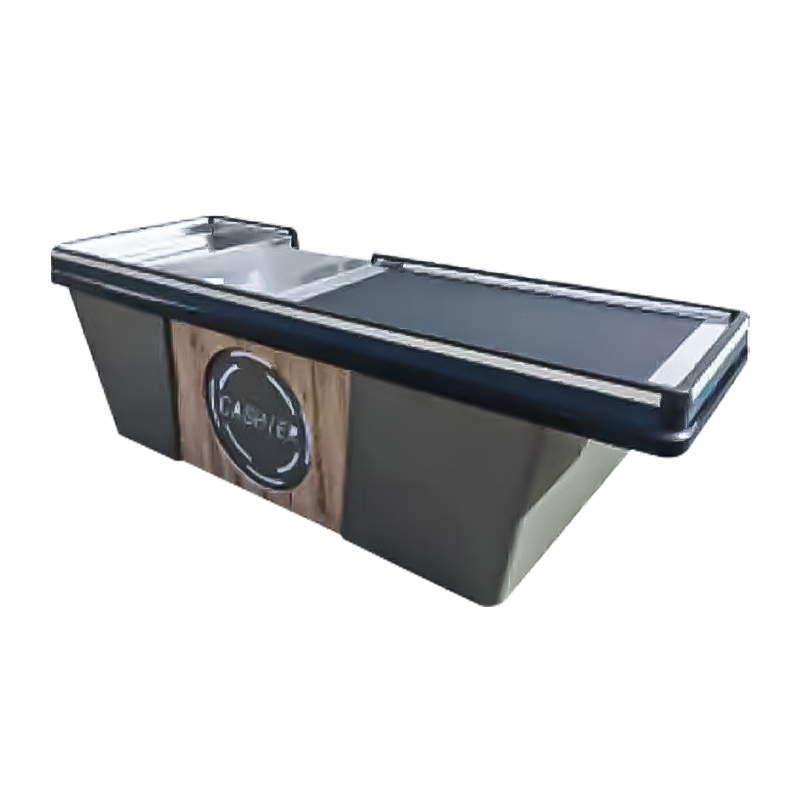
Electric mobile cashier counters are the most capable category for supermarket and large-format retail applications. These units use a motorized mobility platform to reposition the full counter — including conveyor belt, POS hardware, and cash management components — without manual pushing. They are designed for repeated repositioning across a standard retail floor, and their self-contained power systems mean they can operate at any location in the store without infrastructure dependency. The mobile belt checkout counter with a flexible repositioning system represents this category at its most operationally capable.
Wheeled push counters are a step down in capability but still suitable for lighter-use scenarios — convenience store satellite stations, pharmacy checkout points, or low-volume promotional setups. These units use locking casters rather than motorized drive, so repositioning requires manual effort. They are typically lighter and lower-cost than electric units, and appropriate when the frequency of repositioning is low and the distances involved are short.
Modular and folding counters are the most portable in the literal sense — they disassemble or fold for transport and storage — but they are least suitable for serious retail use. Assembly time, reduced structural stability, and limited POS integration capability make them more appropriate for trade show booths, craft market stalls, and pop-up events than for daily supermarket operations. If your use case involves a permanent or semi-permanent retail environment with daily operation, modular counters should not be the first choice.
Operational Benefits Beyond Just "Moving Around"
The immediate appeal of a portable cashier counter is the ability to move it. The operational benefits, however, go further than the mobility itself.
Elimination of rewiring costs is significant for any store that has tried to add or relocate a checkout point using fixed infrastructure. Electrical work in a live retail environment is disruptive and expensive — it typically requires after-hours scheduling, licensed contractors, permit processes, and modification of floor or wall infrastructure. A portable counter eliminates all of this. The cost of repositioning is staff time measured in minutes, not contractor invoices measured in thousands.
Faster promotional response changes what is operationally feasible during campaigns. With fixed infrastructure, placing a transaction point near a promotional display requires advance planning and installation — which means the decision has to be made weeks before the event. With a portable counter, the decision can be made the day before, or even the morning of. That responsiveness has real commercial value: checkout proximity to a promotional area measurably increases transaction rates on impulse items.
Improved floor space utilization follows from the ability to store portable counters when not in use. A fixed lane that is closed during off-peak hours still occupies floor space, obstructs customer flow, and signals an unbalanced store layout. A portable counter that is returned to a compact storage position when not needed frees that floor area for merchandising or traffic flow — a meaningful gain in stores where every square meter of selling space carries a cost.
Staff deployment efficiency improves when checkout capacity can be matched precisely to demand. A store with portable cashier counters can open exactly the number of lanes the current traffic level requires, rather than choosing between under-serving peak demand and overstaffing quiet periods. The result is better customer experience during busy times and lower labor cost during slow ones.
How to Select the Right Portable Cashier Counter for Your Store
The right portable cashier counter is determined by the specific operational context — not by general specifications. These are the evaluation criteria that matter most for retail buyers.
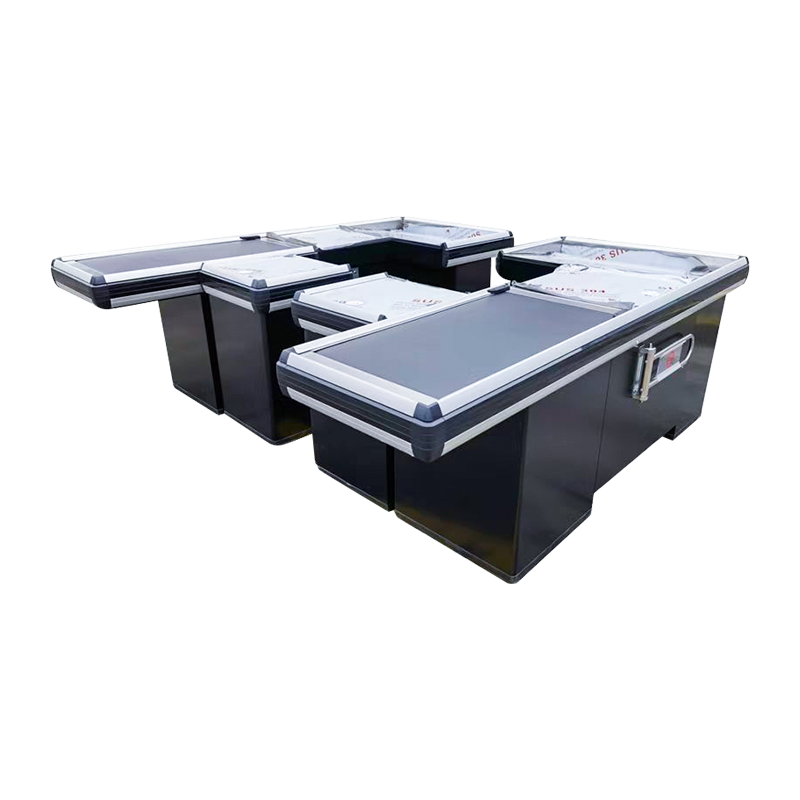
Traffic volume per lane determines whether a conveyor belt is necessary. For a supermarket lane handling full grocery baskets, a belt is operationally essential. For a convenience store satellite station handling smaller transactions, a flat-surface counter may be adequate. Matching the counter configuration to the expected transaction type prevents both over-specification and under-performance. For environments where transaction volume is high and speed is critical, a multi-payment belt checkout counter designed for busy retail environments sets the appropriate performance benchmark.
Battery runtime should be evaluated against the longest expected deployment period without access to a charging point. A unit rated for six hours of continuous operation is adequate for a standard shift; one rated for four hours may require mid-shift recharging that disrupts operations. Ask suppliers for real-world runtime data under typical load conditions, not theoretical maximums from battery specification sheets.
POS system compatibility must be confirmed before purchase, not assumed. Most portable counters support standard POS hardware, but the specific payment terminal models, scanner types, and customer display configurations your store uses may require verification. A supplier who cannot confirm compatibility with your existing POS setup before the order is placed is not a suitable vendor for commercial equipment.
Footprint in transit vs. in operation are two different dimensions. The operating footprint determines how much floor space the counter occupies during use; the transit footprint determines whether it can navigate the store's aisles, doorways, and service corridors during repositioning. Both need to be measured against your actual store geometry, not against generic aisle-width standards.
Customization options for brand consistency matter for customer-facing equipment. Color, panel material, logo placement, and surface finish affect how the counter integrates with the store's visual identity — particularly important for promotional setups where the checkout point is a visible part of the brand experience.
Common Mistakes Retailers Make When Buying Portable Checkout Equipment
Prioritizing price over stability. The lowest-cost portable counter on the market is almost always a folding or lightweight unit designed for intermittent light use. Deploying it in a daily supermarket environment produces predictable results: instability under load, premature wear on joints and casters, and a customer-facing unit that looks and feels less substantial than the fixed counters around it. The cost of replacing an under-specified unit within 18 months exceeds the initial saving.
Underestimating power requirements. Electric cashier stations — conveyor motor, POS terminal, barcode scanner, customer display, payment terminal — draw more power than buyers typically estimate. Battery systems that appear adequate on paper may fall short in real operating conditions, particularly in temperature-controlled environments where battery performance degrades. Request runtime testing data at operating temperature, not just ambient lab conditions.
Skipping POS integration verification. It is not uncommon for buyers to receive portable counters that are mechanically excellent but incompatible with the store's existing payment or POS infrastructure. By the time this is discovered, the equipment has been delivered and the supplier's leverage to resolve the issue is reduced. Confirm integration in writing before placing the order.
Not planning for storage. A portable counter that has no defined storage position when not in use tends to end up parked in an ad-hoc location — often in a way that blocks service corridors or creates a visual obstacle on the sales floor. Storage location, power access for charging, and the process for retrieving and deploying the unit should all be defined before the equipment arrives. For a full overview of available configurations across fixed and mobile formats, the complete checkout counter lineup provides the comparison basis needed for an informed decision.