 English
 Español
 русский
 عربى
عربى 中文简体
中文简体
Content
The Problem with Fixed Checkout Counters
Saturday afternoon in a busy supermarket: four checkout lanes are open, three have lines stretching into the aisles, and the fresh produce section on the far side of the store is completely clear. The store has the staff. It has the equipment. What it doesn't have is the ability to move a checkout counter from where it isn't needed to where it is.
This is the core limitation of fixed checkout counters. They work well when customer traffic is predictable and evenly distributed — which, in most retail environments, it rarely is. Peak hours, promotional events, seasonal rushes, and store layout changes all create situations where a checkout counter bolted to one location becomes a bottleneck rather than a solution. Adding more fixed lanes means more construction, more wiring, and more permanent infrastructure that sits idle most of the time.
For supermarkets and large-format retailers, this rigidity carries a real operational cost. Staff are redeployed away from customer service to manage queue overflow. Customers abandon purchases when lines are too long. And during slow periods, fully equipped checkout stations sit unused, occupying floor space that could be generating revenue. The mobile checkout counter was developed specifically to solve this mismatch between static infrastructure and dynamic customer flow.
What Is a Mobile Checkout Counter
A mobile checkout counter is a fully functional point-of-sale station built on a mobility system that allows it to be repositioned across a store without dismantling, rewiring, or reconstruction. Unlike a fixed checkout counter — which is anchored to the floor and hardwired into the store's electrical and data infrastructure — a mobile unit integrates its power supply, POS compatibility, and scanning surface into a self-contained structure that can be moved as a complete unit.
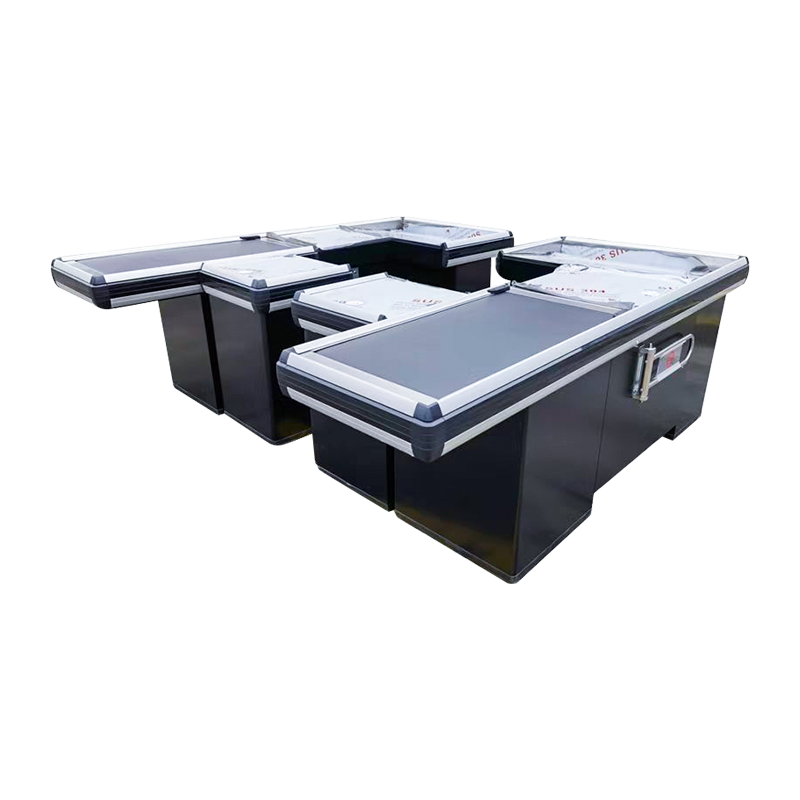
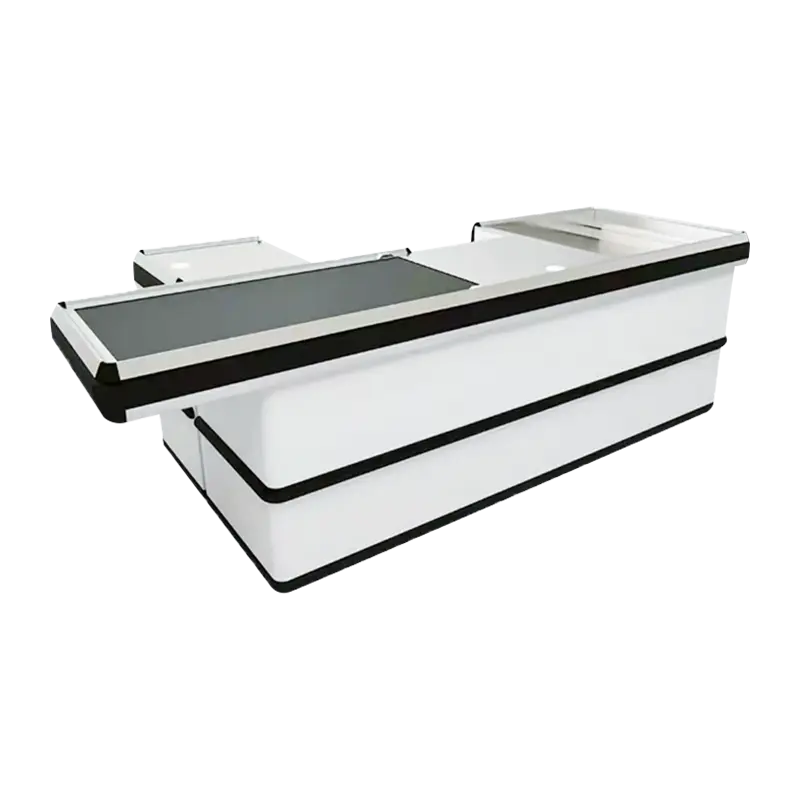
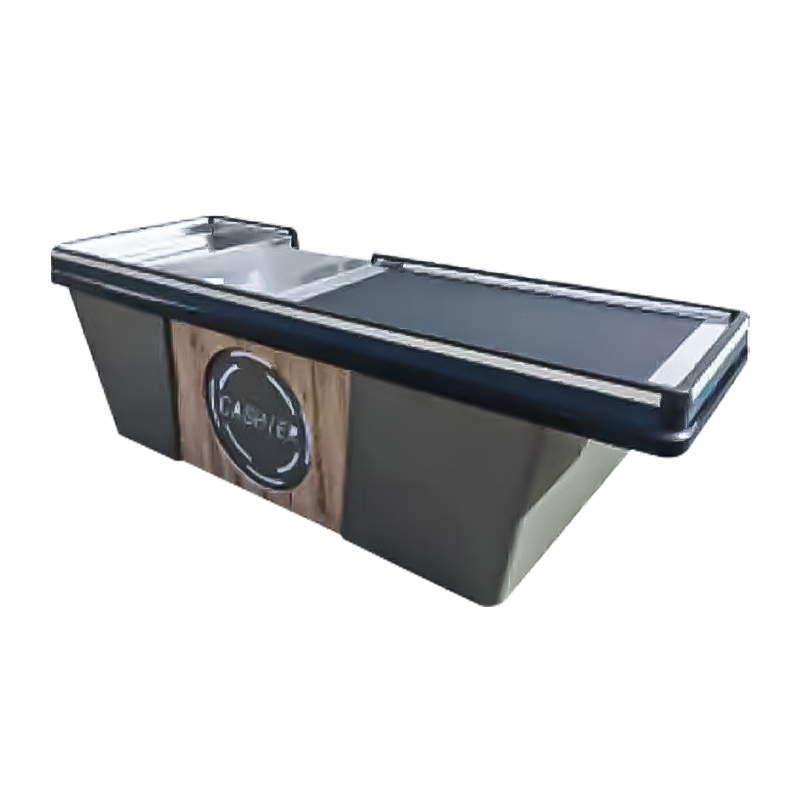
The functional components are identical to those of a standard checkout counter: a work surface for scanning and bagging, a space for the POS terminal and payment hardware, and typically a conveyor belt or item staging area. What changes is the base. Instead of a fixed frame, a mobile checkout counter sits on a wheeled or motorized platform designed to support the full weight of the unit and its operational load while remaining maneuverable in typical retail floor conditions.
The distinction matters for procurement decisions. A portable folding table with a cash drawer is not a mobile checkout counter in any meaningful operational sense. A genuine mobile checkout counter is purpose-built retail equipment, engineered to perform at the same standard as its fixed counterparts — just without the permanent footprint.
How the Mobility System Works
The mobility system is what separates a functional mobile checkout counter from a piece of furniture on wheels. In an electric mobile checkout counter, the movement mechanism is motorized — the unit can be guided to its new position without the physical effort of manually pushing a heavy, fully equipped station across a retail floor. This matters more than it might sound: a checkout counter with a conveyor belt, POS hardware, and a full cash drawer can weigh considerably more than it appears, and requiring staff to manually relocate it multiple times per shift creates both a fatigue problem and a safety risk.
Beyond the drive mechanism, the key engineering challenge in a mobile checkout counter is power. Fixed counters draw from hardwired electrical connections. A mobile unit needs either an onboard power source — typically a high-capacity rechargeable battery system — or a design that allows for rapid, tool-free connection to standard floor outlets at each position. The better-designed systems manage this without trailing cables across the floor, which would create a trip hazard and defeat the purpose of flexible positioning.
Data connectivity for the POS system follows a similar logic. Modern mobile checkout counters typically use wireless network connections for POS communication, eliminating the need to reconnect data cables each time the unit moves. The result is a station that can be repositioned in minutes — not hours — with no tools, no contractor, and no disruption to ongoing store operations.
Key Scenarios Where Mobile Counters Deliver Real Value
Peak hour traffic management is the most immediate application. Weekends, lunch hours, and post-work evenings create predictable demand spikes that fixed checkout infrastructure handles poorly. A supermarket with six fixed lanes and four mobile units can operate all ten during peak periods and consolidate to four or five during off-peak hours — matching staffing levels and lane count to actual demand rather than planning for worst-case scenarios with permanent infrastructure.
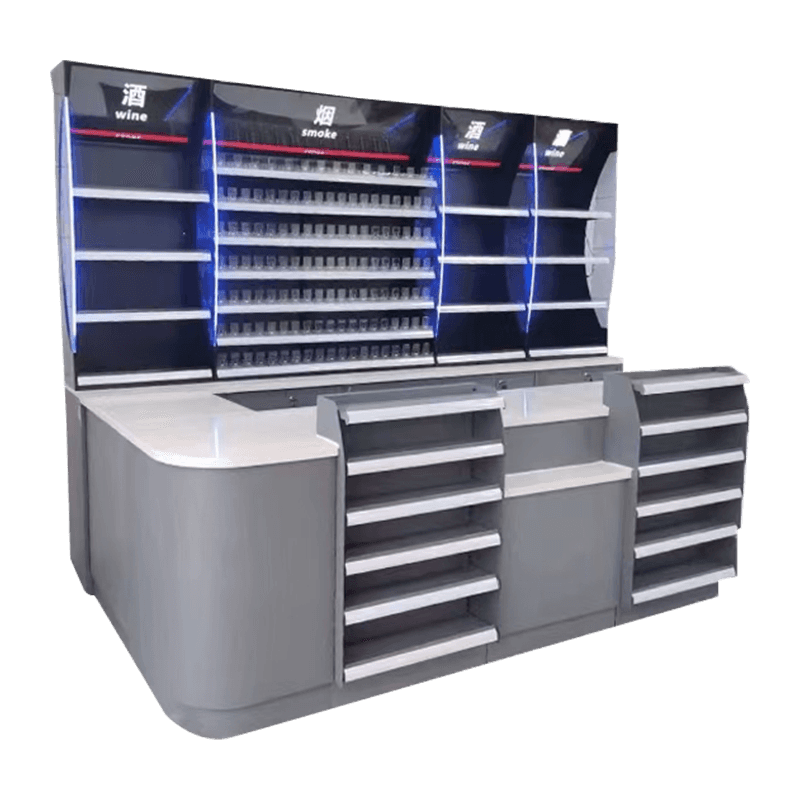
Promotional events and seasonal campaigns are another high-value scenario. A store setting up a promotional zone for a weekend sale — a wine display, a seasonal food feature, a pharmacy pop-up — benefits from having a checkout point close to the promotional area rather than routing customers back to the main checkout bank. A mobile counter can be positioned next to the display, staffed for the duration of the event, and returned to its base location when the promotion ends. No installation, no removal, no residual fixed infrastructure in the middle of the sales floor.
Store layout changes and remodels create temporary situations where the fixed checkout infrastructure may be partially or fully out of service. Mobile counters provide operational continuity during these periods without requiring parallel permanent installations. For multi-payment belt checkout counters designed for busy retail environments, the ability to relocate during remodeling phases also means the equipment investment continues to generate return rather than sitting idle behind construction barriers.
Multi-zone rotation is a longer-term operational strategy where a store maintains fewer total checkout units than it would need if all lanes were always active, rotating mobile units between areas based on time-of-day traffic patterns. This reduces the total equipment investment while maintaining service levels across the floor — a particularly useful approach for large-format stores with distinct zones that peak at different times.
What to Look for When Choosing a Mobile Checkout Counter
Structural stability is the first criterion and the one most often underweighted in initial purchasing decisions. A checkout counter that wobbles under the weight of a conveyor belt load, or that shifts when a customer leans on it, creates both a safety issue and a customer experience problem. The mobility system should lock securely when the unit is in its operating position — casters with positive locking mechanisms, or a motorized platform with a dedicated stationary mode, are the minimum standard.
The power and connectivity system determines how genuinely mobile the unit is in practice. Battery capacity should be rated for a full operating shift without recharging — units that need to be taken offline to recharge mid-shift are not operationally mobile. Wireless POS connectivity should be verified against the store's existing network infrastructure before purchase, as not all mobile units are compatible with all POS systems out of the box.
Conveyor belt integration is relevant for supermarket applications where item volume per transaction is high. A mobile counter without a belt may be adequate for a convenience store or pharmacy satellite station, but for a full-service supermarket lane, the belt is typically necessary for operational parity with fixed lanes. For applications where throughput is a priority, a heavy-duty belt checkout counter built for continuous use sets the appropriate performance benchmark.
Dimensions and floor clearance matter for maneuverability in tight spaces. A unit that is too wide to navigate standard supermarket aisle widths when repositioning is a practical problem regardless of how well it performs as a stationary counter. Measure the narrowest passage the unit will need to pass through during repositioning, and verify the unit's moving footprint — which may differ from its operating footprint — against those dimensions.
Finally, material durability should reflect the intensity of use. Mobile units are handled more frequently than fixed counters — they are moved, locked, unlocked, and potentially subjected to the stresses of repeated repositioning. Countertop surfaces, frame joints, and wheel assemblies should be rated for commercial-grade continuous use, not light-duty intermittent applications.
Mobile vs. Fixed: A Practical Comparison
The most direct comparison between mobile and fixed checkout counters comes down to three operational variables: deployment time, cost of change, and utilization rate.
Deployment time for a fixed checkout counter — from the decision to add a lane to operational readiness — involves construction planning, electrical work, data cabling, and physical installation. In a live retail environment, this typically means after-hours work over multiple nights, with associated contractor costs and operational disruption. A mobile checkout counter is operational wherever it is positioned, typically within minutes of arrival at the new location.
Cost of change for a fixed counter is high in both directions: adding one requires infrastructure investment, and removing or relocating one leaves behind floor penetrations, capped wiring, and often a visible scar on the store layout. Mobile counters have no cost of repositioning beyond staff time, and no residual footprint when moved.
Utilization rate is where the economics of mobile counters often surprise first-time buyers. A fixed counter that is only active during peak periods has a utilization rate that may be 30–40% of total store hours. A mobile counter that serves the main checkout bank during peak hours and moves to a promotional zone or satellite location during off-peak periods can maintain a much higher utilization rate against the same capital investment. For a complete view of available configurations, the full range of checkout counter solutions covers both fixed and mobile options across different operational requirements.