 English
 Español
 русский
 عربى
عربى 中文简体
中文简体
Content
- 1 Why the Checkout Counter Defines the Convenience Store Zone
- 2 Countertop Design That Serves Both Cashiers and Customers
- 3 Front-Facing Display Fixtures: Converting Dwell Time into Sales
- 4 Built-In Storage: Keeping the Workspace Organized
- 5 How Grocery Store Display Cabinets Differ from Convenience Checkout Units
- 6 Materials, Durability, and Aesthetic Considerations
- 7 Which Retail Formats Benefit Most from This Checkout Solution
Why the Checkout Counter Defines the Convenience Store Zone
In any retail environment, the checkout area is the final touchpoint between the customer and the store. In a convenience store zone specifically, this space carries disproportionate commercial weight — it is where every transaction is completed, where impulse purchases are won or lost, and where the customer's last impression of the store is formed. Despite its importance, the checkout counter in many convenience stores remains an afterthought: cluttered, undersized, and poorly organized. A purpose-designed checkout display counter changes this dynamic entirely.
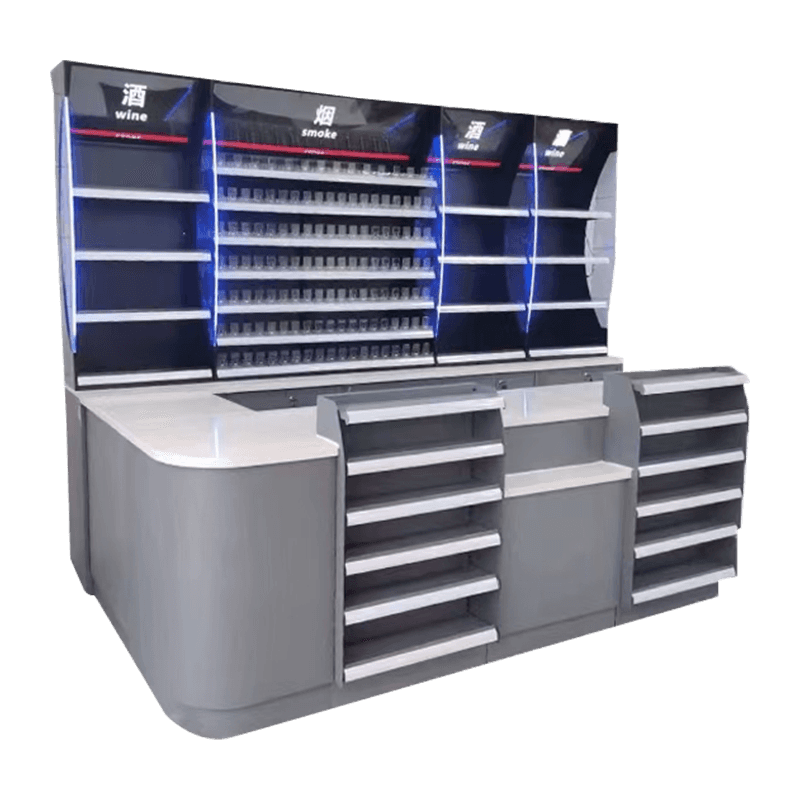
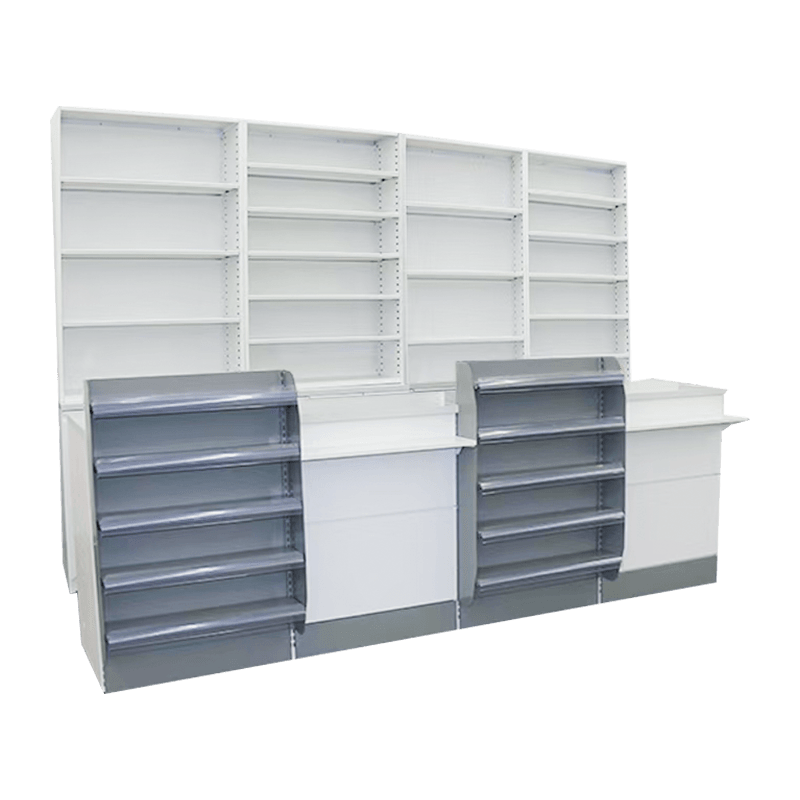
The checkout display counter series designed for convenience store zones integrates ergonomic principles with retail merchandising logic. The result is a compact, functional unit that fits within the tight floor plans typical of convenience formats — whether a neighborhood store of 50 square meters or a gas station shop of 30 — while simultaneously serving as a revenue-generating display surface. Every design decision, from countertop depth to fixture height, is calibrated to improve both cashier efficiency and customer purchasing behavior during the checkout process.
Countertop Design That Serves Both Cashiers and Customers
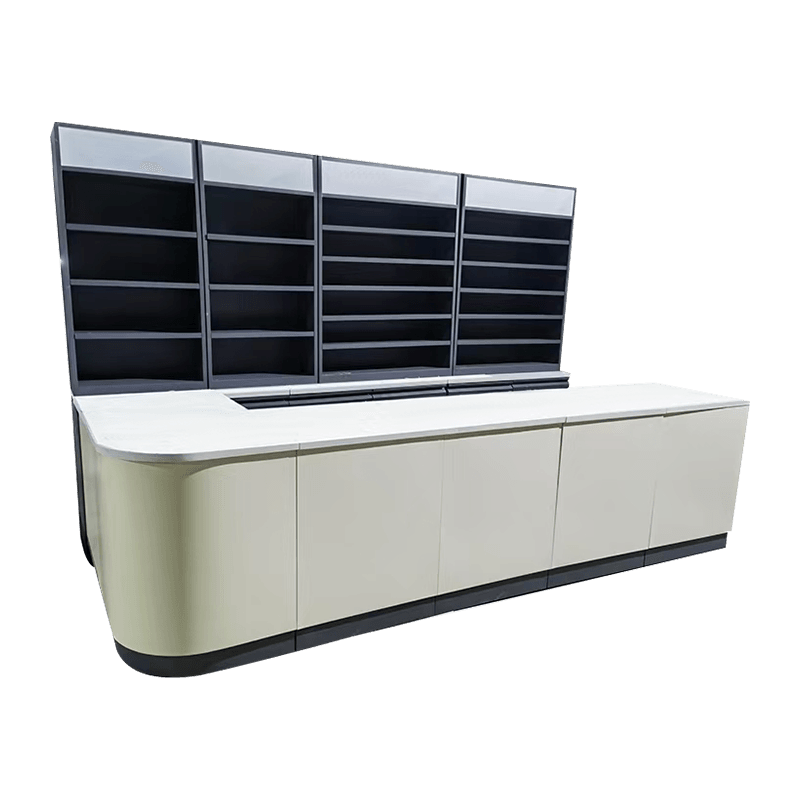
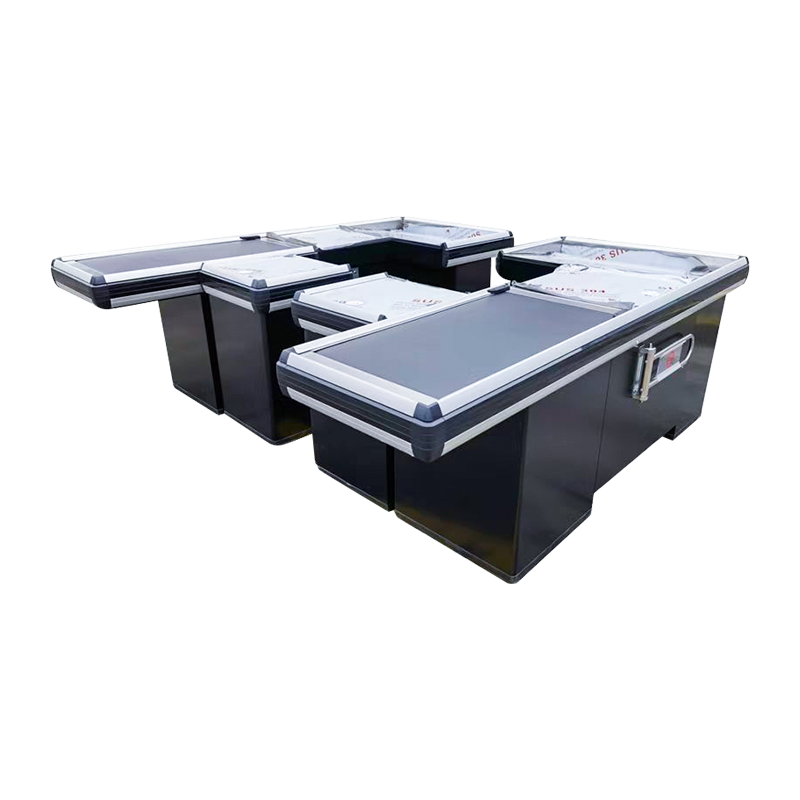
The countertop is the operational core of the checkout station. A well-designed surface must accommodate the cashier's workflow — scanning, bagging, payment processing — without creating friction or requiring awkward reach. The spacious, smooth countertop on this series provides a clear working plane that allows cashiers to operate efficiently during peak traffic periods when transaction speed directly affects customer satisfaction scores and queue length.
Beyond the transactional function, the countertop serves a secondary merchandising role that many store operators underutilize. The area immediately adjacent to the payment terminal is prime real estate for small, high-margin impulse-buy items. Products such as chewing gum, mints, lighters, travel-size hand sanitizers, and single-serve snacks placed at this location capture the attention of customers who have already committed to a purchase and are waiting for payment to process. Studies in convenience retail consistently show that well-curated countertop displays convert at significantly higher rates than equivalent shelf placements elsewhere in the store, precisely because the customer has no competing navigation task at this moment.
The finely treated surface finish — stain-resistant and easy to clean — is a practical necessity in this context. Checkout counters in high-traffic convenience store zones accumulate spills, product residue, and general handling marks rapidly. A surface that cleans down quickly between shifts maintains a fresh, professional appearance that reinforces brand image without adding to staff maintenance workload.
Front-Facing Display Fixtures: Converting Dwell Time into Sales
The customer-facing front panel of the checkout display counter is one of the most consistently overlooked promotional spaces in convenience store design. Unlike shelving located in the store's interior aisles, the front of the checkout counter is seen by every single customer at the moment of highest engagement — when they are stationary, waiting, and receptive to visual stimuli. Multi-tier display fixtures mounted to this front panel transform passive dwell time into active product discovery.
Tiered Shelf Configuration for Maximum Visibility
The multi-tier format stacks product categories vertically, allowing store owners to organize merchandise by type, margin, or promotional priority. Trending products and new arrivals benefit most from this placement — the eye-level and just-below-eye-level tiers command the strongest customer attention, while lower tiers remain effective for established impulse categories with strong brand recognition. Rotating the products displayed in this space weekly or bi-weekly keeps the fixture visually fresh and encourages repeat customers to notice and consider new options.
Special Offers and Limited-Time Promotions
The high-visibility front panel is also the ideal location for time-sensitive promotions. Special offers displayed here reach 100% of the customer base without requiring any additional floor space or signage investment. For chain convenience stores running coordinated promotions across multiple locations, a standardized checkout display counter with consistent fixture dimensions simplifies rollout and ensures uniform visual presentation at every checkout zone.
Built-In Storage: Keeping the Workspace Organized
Operational clutter behind the checkout counter is a persistent problem in convenience store environments. Backup receipt rolls, plastic bags, cleaning supplies, spare batteries for POS terminals, and staff personal items frequently accumulate on and around the counter, undermining the clean appearance the store projects to customers. Models in this checkout display counter series address this directly with built-in storage cabinets integrated into the counter body.
These enclosed storage compartments allow staff to keep operational necessities within arm's reach without exposing them to customer view. The workspace remains visually uncluttered, and staff can locate items quickly during busy periods without searching through disorganized surface accumulation. For stores that also stock controlled items — tobacco products, lottery tickets, or age-restricted goods — locked cabinet configurations provide secure, compliant storage within the checkout zone itself, reducing the need for separate secure storage areas that consume additional floor space.
How Grocery Store Display Cabinets Differ from Convenience Checkout Units
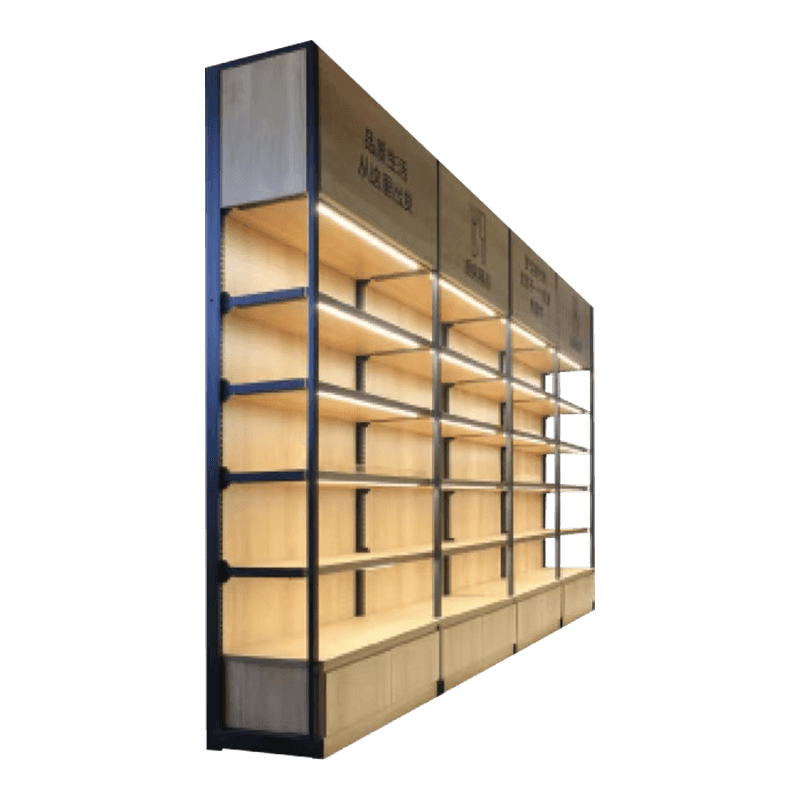
Understanding the distinction between grocery store display cabinets and convenience store checkout display counters helps retailers select the right merchandising equipment for each context. While both categories serve product display functions, their design priorities diverge significantly based on store format, customer behavior, and space constraints.
| Feature | Grocery Store Display Cabinets | Convenience Store Checkout Counter |
|---|---|---|
| Primary function | Browse-mode product display across wide store aisles | Transaction facilitation and impulse-buy capture at checkout |
| Space requirement | Large footprint; suited to supermarket floor plans | Compact; designed for constrained convenience store zones |
| Customer interaction | Active browsing; customer controls pace | Passive exposure during stationary checkout wait |
| Integrated work surface | Not required | Essential; supports POS terminal and cashier operations |
| Staff storage | Separate backroom or stockroom | Built-in cabinet for operational items |
Grocery store display cabinets are engineered for browse-mode retail — wide aisles, extended customer dwell, and product categories that benefit from comparison shopping. Checkout display counters for the convenience format are engineered for the opposite scenario: a customer who has already decided to purchase, is stationary for 30 to 90 seconds, and can be reached with high-margin, low-consideration impulse products at minimal additional cost to the retailer.
Materials, Durability, and Aesthetic Considerations
High-traffic convenience store environments subject checkout fixtures to sustained physical stress — constant contact from customers and staff, frequent cleaning with commercial products, and the general mechanical wear of continuous daily operation. The checkout display counter series addresses this through high-quality, durable materials with verified weight-bearing capacity and wear resistance. The structural framework and countertop substrate are selected to maintain dimensional stability and surface integrity across years of continuous use without warping, delaminating, or losing load capacity.
Certain models in the series incorporate a sleek, streamlined design with metallic accents — brushed aluminum trim, chrome hardware, or powder-coated steel framing — that aligns the checkout area's aesthetic with the modern, polished interior style of contemporary convenience store formats. For chain operators with defined brand standards, this design flexibility allows the checkout counter to reinforce rather than contradict the store's visual identity. A checkout zone that looks deliberate and well-maintained communicates quality and operational professionalism to customers in a way that mismatched or worn fixtures cannot.
Which Retail Formats Benefit Most from This Checkout Solution
The checkout display counter series is applicable across a broad range of convenience-format retail environments, each of which shares the characteristic of limited floor space combined with high customer throughput:
- Neighborhood convenience stores: Typically operating in 40–80 square meter footprints, these stores benefit most from the compact design and integrated display capability — every square meter of floor and surface space must generate revenue.
- Chain supermarkets with express lanes: Express checkout lanes in larger supermarkets share the space and throughput characteristics of standalone convenience stores. A dedicated checkout display counter optimized for impulse categories outperforms standard checkout fixtures in these lanes.
- Gas station shops: Forecourt retail is one of the highest-impulse convenience formats. Customers entering to pay for fuel have a short, purposeful visit — a well-designed checkout zone with prominent front-panel displays and countertop impulse items captures a significant share of add-on purchases.
- Boutique retail outlets: Specialty food, health product, and lifestyle boutiques that operate on compact footprints use checkout display counters to present curated accessory and add-on products without displacing primary merchandise space.
Across all these formats, the core value proposition remains consistent: a checkout display counter that combines efficient transaction processing with structured impulse merchandising delivers measurable improvement in average transaction value, staff productivity, and the overall shopping experience — making it one of the highest-return equipment investments available to convenience store operators.